
The Hidden Revenue Gap: Why You Don’t Have a Lead Problem
The Hidden Revenue Gap: Why You Don’t Have a Lead Problem
Mar 24, 2026
Stop losing revenue in your inbox. Learn how to close the "Hidden Revenue Gap" by optimizing response times and automating customer conversations.
Stop losing revenue in your inbox. Learn how to close the "Hidden Revenue Gap" by optimizing response times and automating customer conversations.
Sales Automation, Lead Leakage, Response Time, Convogenie AI, Customer Messaging, Conversational Sales.
Sales Automation, Lead Leakage, Response Time, Convogenie AI, Customer Messaging, Conversational Sales.
The Hidden Revenue Gap: Why You Don’t Have a Lead Problem
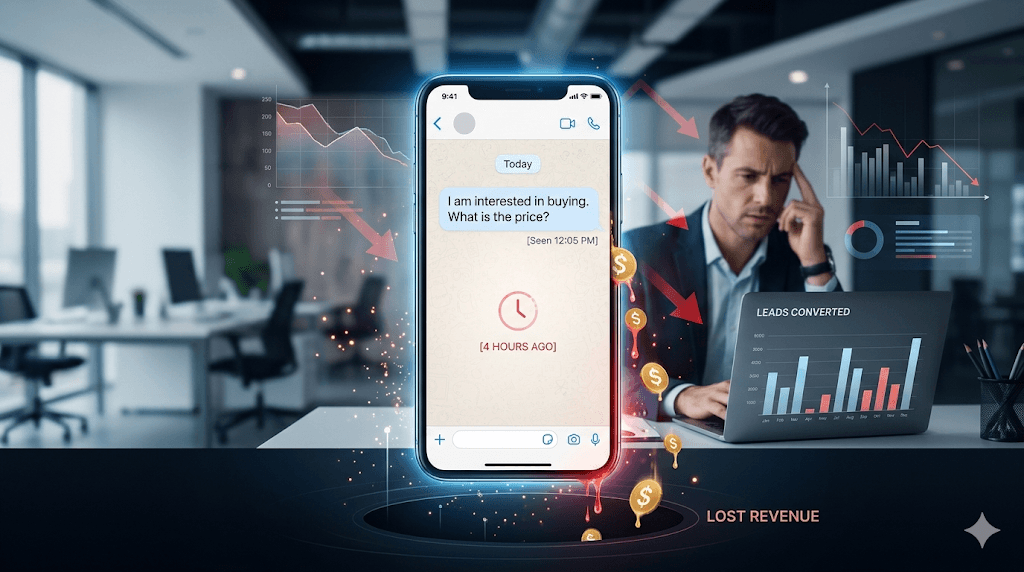
The silent friction between customer intent and business response.
Most businesses operate under a fixed belief: if revenue isn't growing, they simply need more leads. This leads to a reactive cycle of increasing ad budgets, launching more aggressive campaigns, and pushing for higher enquiry volumes. However, the uncomfortable truth is that you might not need more leads at all. You might just be losing the ones who are already standing at your front door, ready to buy.
The real gap in your growth strategy often isn’t at the top of the funnel—it’s tucked away inside your actual customer conversations.
The Moment That Actually Decides Revenue
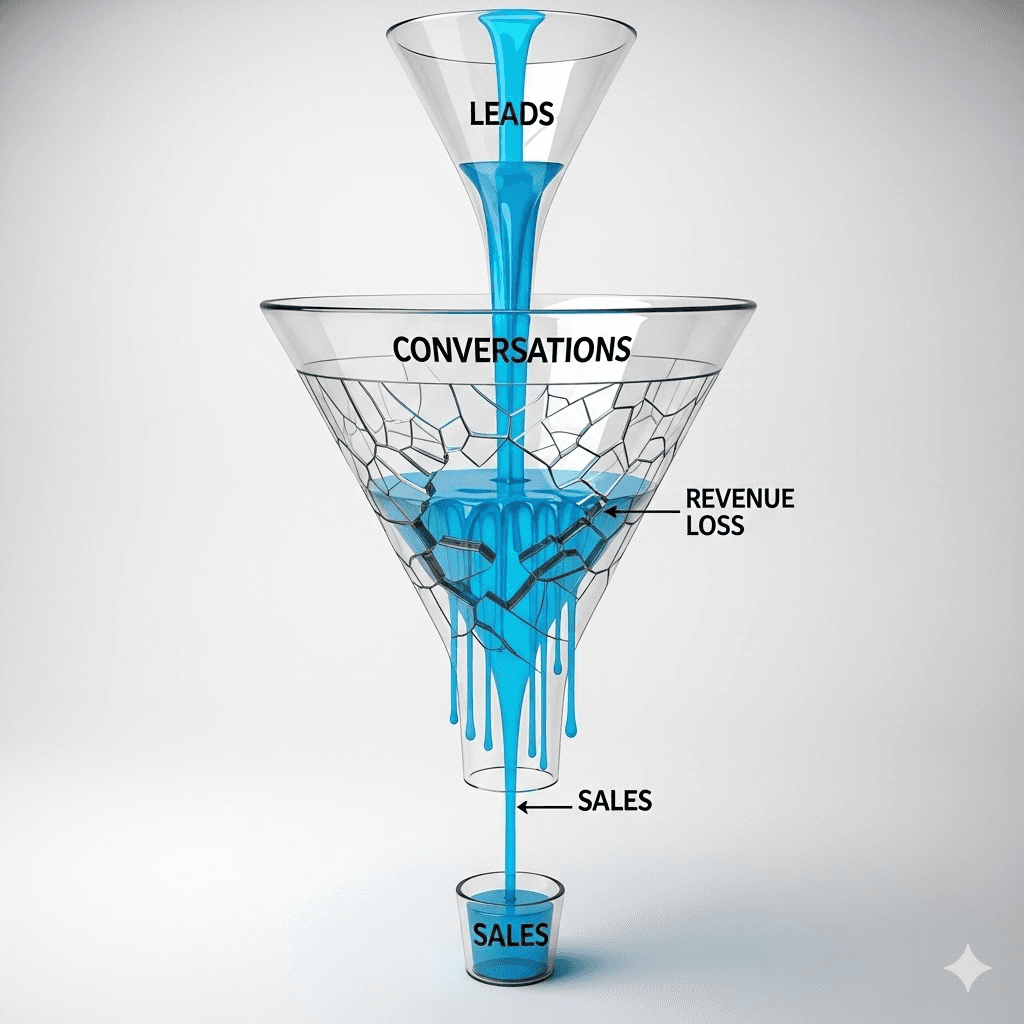
When a customer messages your business, it is rarely a random act. By the time they hit "send," they have already seen your product, developed an interest, and taken the active effort to reach out. That message is more than a simple enquiry; it is a decision in progress. Yet, a staggering number of these high-intent conversations never reach a conversion. This failure usually isn't due to a lack of interest in the product, but because the conversation simply failed to move forward when it mattered most.
To fix this, businesses must shift their mindset: Conversations are not support—they are sales. Watch: Why Your Marketing Funnel Is Broken (And How to Fix It)
Why Speed Now Wins Over Everything Else: In today's market, customers do not wait. They are likely messaging multiple businesses simultaneously and comparing options in real-time. This creates a razor-thin "decision window" where whoever responds first usually wins the race.
A landmark Harvard Business Review study on lead response life-cycles found that firms that contact prospects within an hour are seven times more likely to have a meaningful conversation than those who wait even sixty minutes. In the modern economy, the fastest response often beats the "best" product simply by being present at the moment of intent.
Learn more: How to Win Deals in Under 1 Minute (391% Conversion Lift)
Where Revenue Quietly Slips Away
Revenue loss is rarely a dramatic event; it’s a slow leak caused by small, everyday friction points. Individually, these gaps—like a missed Instagram DM or a forgotten follow-up—seem harmless. But collectively, they decimate your conversion rate.
According to reports on the rising demand for real-time engagement, customers now expect seamless, omnichannel experiences. When your conversations are scattered across WhatsApp, Instagram, and web chat, you aren't just being "unorganized"—you are actively eroding customer trust. Every enquiry has already cost you money in ad spend; losing it in the inbox is a waste of your existing investment.
Watch: How to Turn Chats Into Sales With Conversational Growth Strategy

Strategic Fixes: The Response Framework
You don’t need a massive, convoluted system to bridge this gap. Small, structural changes to your communication workflow can move the needle immediately.
The Friction Point | The Strategic Fix | Why It Works |
Slow Initial Response | Implement "Acknowledgment" Templates | Keeps the lead engaged and buys your team time to find a full answer. |
Repetitive FAQ Bottlenecks | Deploy "Ready Responses" | Stop typing price and availability from scratch. Ensures speed and brand consistency. |
The "Silent" Drop-off | The 24-Hour Follow-Up Rule | Most sales happen in the follow-up. A simple check-in can revive a distracted lead. |
Fragmented Platforms | Centralize Into a Unified Inbox | Bringing WhatsApp, IG, and Web into one view ensures zero missed messages. |
Scaling the Human Touch
As your business grows, so do your messages. Suddenly, you can’t reply instantly, and quality becomes inconsistent. In the modern B2B buying journey, customers spend very little time with sales reps and need instant info to make decisions.
This is where automation moves from "nice to have" to "essential." Systems like Convogenie are built to support your team, not replace them. By using AI to handle instant replies and automated follow-ups, you ensure that no customer is lost just because you weren't available.
Conclusion: The Revenue Gap You’re Not Tracking
Revenue loss is not always about a lack of demand. The gap between customer intent and your response is where most businesses lose money. Your next customer is likely already in your inbox—the only question is whether you will respond in time to keep them there.
The Hidden Revenue Gap: Why You Don’t Have a Lead Problem
The silent friction between customer intent and business response.
Most businesses operate under a fixed belief: if revenue isn't growing, they simply need more leads. This leads to a reactive cycle of increasing ad budgets, launching more aggressive campaigns, and pushing for higher enquiry volumes. However, the uncomfortable truth is that you might not need more leads at all. You might just be losing the ones who are already standing at your front door, ready to buy.
The real gap in your growth strategy often isn’t at the top of the funnel—it’s tucked away inside your actual customer conversations.
The Moment That Actually Decides Revenue
When a customer messages your business, it is rarely a random act. By the time they hit "send," they have already seen your product, developed an interest, and taken the active effort to reach out. That message is more than a simple enquiry; it is a decision in progress. Yet, a staggering number of these high-intent conversations never reach a conversion. This failure usually isn't due to a lack of interest in the product, but because the conversation simply failed to move forward when it mattered most.
To fix this, businesses must shift their mindset: Conversations are not support—they are sales. Watch: Why Your Marketing Funnel Is Broken (And How to Fix It)
Why Speed Now Wins Over Everything Else: In today's market, customers do not wait. They are likely messaging multiple businesses simultaneously and comparing options in real-time. This creates a razor-thin "decision window" where whoever responds first usually wins the race.
A landmark Harvard Business Review study on lead response life-cycles found that firms that contact prospects within an hour are seven times more likely to have a meaningful conversation than those who wait even sixty minutes. In the modern economy, the fastest response often beats the "best" product simply by being present at the moment of intent.
Learn more: How to Win Deals in Under 1 Minute (391% Conversion Lift)
Where Revenue Quietly Slips Away
Revenue loss is rarely a dramatic event; it’s a slow leak caused by small, everyday friction points. Individually, these gaps—like a missed Instagram DM or a forgotten follow-up—seem harmless. But collectively, they decimate your conversion rate.
According to reports on the rising demand for real-time engagement, customers now expect seamless, omnichannel experiences. When your conversations are scattered across WhatsApp, Instagram, and web chat, you aren't just being "unorganized"—you are actively eroding customer trust. Every enquiry has already cost you money in ad spend; losing it in the inbox is a waste of your existing investment.
Watch: How to Turn Chats Into Sales With Conversational Growth Strategy
Strategic Fixes: The Response Framework
You don’t need a massive, convoluted system to bridge this gap. Small, structural changes to your communication workflow can move the needle immediately.
The Friction Point | The Strategic Fix | Why It Works |
Slow Initial Response | Implement "Acknowledgment" Templates | Keeps the lead engaged and buys your team time to find a full answer. |
Repetitive FAQ Bottlenecks | Deploy "Ready Responses" | Stop typing price and availability from scratch. Ensures speed and brand consistency. |
The "Silent" Drop-off | The 24-Hour Follow-Up Rule | Most sales happen in the follow-up. A simple check-in can revive a distracted lead. |
Fragmented Platforms | Centralize Into a Unified Inbox | Bringing WhatsApp, IG, and Web into one view ensures zero missed messages. |
Scaling the Human Touch
As your business grows, so do your messages. Suddenly, you can’t reply instantly, and quality becomes inconsistent. In the modern B2B buying journey, customers spend very little time with sales reps and need instant info to make decisions.
This is where automation moves from "nice to have" to "essential." Systems like Convogenie are built to support your team, not replace them. By using AI to handle instant replies and automated follow-ups, you ensure that no customer is lost just because you weren't available.
Conclusion: The Revenue Gap You’re Not Tracking
Revenue loss is not always about a lack of demand. The gap between customer intent and your response is where most businesses lose money. Your next customer is likely already in your inbox—the only question is whether you will respond in time to keep them there.

Convogenie provides advanced autonomous AI agents for intelligent automation and business growth.

Convogenie provides advanced autonomous AI agents for intelligent automation and business growth.
Convogenie provides advanced autonomous AI agents for intelligent automation and business growth.